Could those tiny black specks in the back of your Sacramento pantry be something far more serious than spilled pepper or coffee grounds? Finding mysterious debris in your kitchen often triggers an immediate wave of anxiety about your family's health and the cleanliness of your home. I've talked to many neighbors who feel overwhelmed by this discovery, especially when they aren't sure if they're looking at a minor mess or a growing infestation.
One of the most common questions I get asked is, "what do cockroach droppings look like?" It's a vital question because mistaking roach signs for mouse droppings or simple dirt can lead to the wrong treatment and wasted time. I'm here to give you a definitive guide so you can identify these signs with total confidence. You'll learn exactly how to distinguish roach waste from other pests and understand which species might be hiding in your walls. I'll also provide a clear action plan so you can regain your peace of mind. We will look at the specific sizes and textures left behind by local pests like the American and Turkistan cockroaches, ensuring you know exactly what you're dealing with.
Key Takeaways
- Learn to recognize the visual signs of roach waste, which typically looks like coarse black pepper or coffee grounds depending on the size of the pest.
- I'll explain exactly what do cockroach droppings look like versus mouse droppings so you can use the "ridge test" to identify the culprit correctly.
- Identify the specific roach species in your home by looking at the size and location of the debris, from tiny German roach specks to larger American roach cylinders.
- Find out which "warm zones" in your Sacramento kitchen are most likely to hide these pests so you can target your inspection effectively.
- Follow my professional steps for properly sanitizing contaminated areas to protect your family's health and prevent the infestation from spreading.
Identifying Cockroach Droppings: Size, Shape, and Appearance
When you're staring at a corner of your kitchen floor wondering, "what do cockroach droppings look like?", you're really looking for a sign of how big your problem might be. Most people describe finding what looks like a spill of coarse black pepper or coffee grounds. Unlike mouse droppings, which are often found scattered along a path, roach waste tends to show up in clusters. This happens because roaches are social creatures that congregate in specific harborages near food and water. If you find a concentrated pile of these specks, you've likely found a primary nesting or feeding site.
Beyond the solid bits, I often see "smear marks" in high-traffic areas. These are dark, irregular streaks left on surfaces where roaches crawl frequently. They're essentially liquid waste that dries into a stain, and they're a major red flag that you have a significant population moving through that spot. Understanding cockroach biology and behavior helps explain why these marks appear near cracks, crevices, and door frames where they squeeze into hiding. I've spent years inspecting Sacramento homes, and these smears are often the first thing I look for behind appliances.
Visual Characteristics of Small Roach Feces
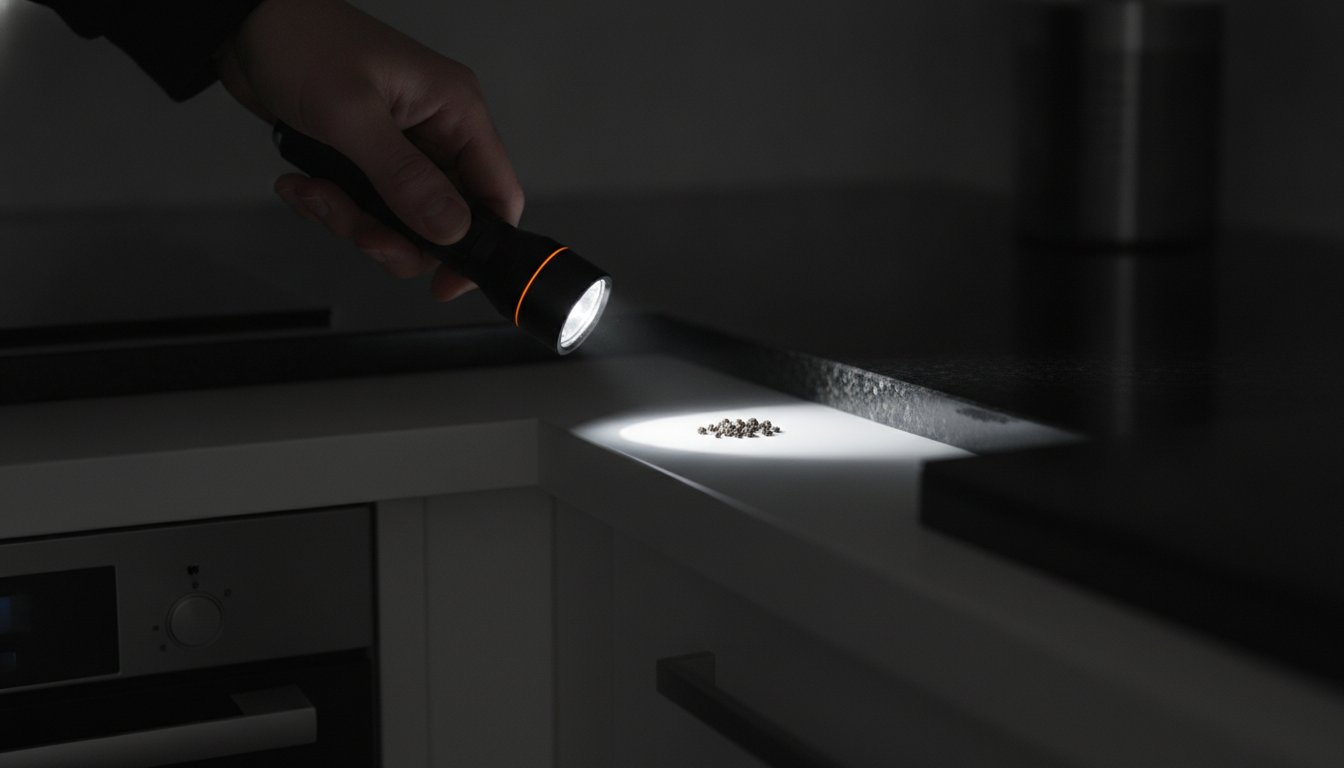
If you're dealing with nymphs or smaller species like the German cockroach, the droppings look like tiny black specks. These "pepper grains" are often sticky when they're fresh. This stickiness allows them to adhere to vertical surfaces or even the undersides of your cabinets and drawers. A single speck is typically less than 1mm in length, making them very easy to miss if you aren't looking closely with a flashlight. I recommend checking the corners of your kitchen drawers; if you see what looks like dirt that doesn't easily brush away, it's likely roach waste.
Visual Characteristics of Large Roach Feces
Larger species, such as the American or Oriental cockroaches common in our area, leave behind something much more substantial. These droppings are cylindrical with blunt ends, often resembling a small seed. The most critical identifying feature I look for is the presence of ridges or grooves running lengthwise down the side of the dropping. The color can range from a deep, dark brown to a stark black, depending on what the roach has been eating in your home. These larger droppings are sometimes mistaken for mouse poop, but those ridges are a dead giveaway that you're dealing with an insect rather than a rodent.
Species Matters: Identifying German vs. American Roach Poop
In our local Sacramento and Roseville neighborhoods, I primarily deal with three specific invaders: German, American, and Oriental cockroaches. While they all leave a mess, the evidence they leave behind varies wildly. If you're wondering what do cockroach droppings look like in your specific home, the answer depends entirely on which species has moved in. Identifying the right pest is the first thing I do when I arrive at a job because a German roach problem requires a completely different approach than an American roach infestation. Knowing Identifying Types of Cockroaches is the best way to start your home inspection.
The German Cockroach: The 'Pepper' Sign
German cockroaches are the most common indoor pest I see in Northern California. They are small, but they are incredibly prolific. Their droppings look like tiny, pepper-like specks. You won't just find one or two; you'll usually find a high volume of them concentrated in one spot. I frequently find these clusters near water sources like kitchen sinks, dishwashers, and bathroom vanities. In cabinet corners, these droppings often look like dark, greasy "staining" rather than individual grains. Finding this pepper-like sign in your kitchen is a red alert. It indicates an active, breeding population that is already established in your home's "warm zones." If you see this type of staining, it's a clear signal that you need Structural Pest Control Services to stop the cycle.
American and Oriental Roaches: The Larger Evidence
American cockroaches leave much larger evidence behind. Their droppings are blunt-ended cylinders about 1/8th of an inch long, roughly the size of a grain of rice. Because of their size and solid consistency, they are frequently mistaken for mouse poop. This is a common point of confusion for homeowners in Auburn and Lincoln. Always remember to look for the ridges; if the dropping has distinct grooves running down the side, it's a roach, not a rodent.
Oriental cockroaches are also common in damp Sacramento crawlspaces and basements. Their droppings are similar in size to the American variety but are usually found in wetter, darker areas of the home. When these larger roaches congregate in high numbers, they produce a distinct, musty odor. It's a heavy, oily smell that often alerts homeowners to a problem before they even see a bug. If you've noticed this scent or found large, ridged droppings, you're likely dealing with one of these larger, moisture-loving species.
Roach Droppings vs. Mouse Droppings: How to Tell the Difference
I've noticed that homeowners in Auburn and Lincoln often lose sleep over this specific question: "Is it a bug or a rodent?" It's the number one thing I'm asked during an initial walk-through. Finding dark specks in your silverware drawer or under the sink is unsettling, and your first instinct might be to just clean it up and forget it. But wait. Before you grab the bleach, you need to know exactly what you're dealing with so you can stop the source. If you want to know what do cockroach droppings look like when compared to mouse signs, you have to look at the fine details.
I always teach my clients the "Ridge Test." If you look closely at a large roach dropping, you'll see tiny grooves or ridges running lengthwise. It looks almost like a miniature piece of licorice. Mouse droppings, on the other hand, are completely smooth and often have a slight shine when they're fresh. Then there's the "End Test." Mice leave behind droppings that are typically pointed at one or both ends. Roach waste is blunt and squared off, looking more like a tiny, dark cylinder. Size also matters here. While American roach droppings can be about 1/8th of an inch, mouse droppings are usually larger, often reaching 1/4 inch in length.
Physical Comparison Checklist
- Ridges: Roach droppings have them; mouse droppings are smooth.
- Ends: Mouse droppings are pointed; roach droppings are blunt.
- Hair: Mouse droppings often contain tiny bits of fur from grooming; roach droppings never do.
- Texture: Mouse droppings crumble when they get old, while roach droppings remain hard and solid.
For those who want to dive deeper into the science of these pests, the University of California's guide to cockroach identification offers a fantastic breakdown of these biological markers. I often share this resource with my customers so they can feel confident in what they're seeing. Identifying these differences correctly is the first step in creating a clear action plan for your property.
Location Clues: Where Each Pest Prefers to 'Go'
Where you find the mess is just as important as what it looks like. Mice are commuters. They leave trails of droppings along baseboards or across the middle of a floor while they travel from their nest to a food source. Roaches are much more stationary. They concentrate their waste in the dark, tight crevices where they spend most of their time. If you see droppings tucked inside a cabinet hinge, behind a picture frame, or in the very back corner of a drawer, you're almost certainly looking at a roach problem. What do cockroach droppings look like in these spots? Usually, they appear as concentrated clusters of pepper-like specks or small cylinders, depending on the species hiding in that gap.

Where to Find Roach Feces in Your Sacramento or Roseville Home
As a local expert who has spent years inspecting everything from Midtown Victorians to modern Roseville developments, I've learned that roaches are incredibly predictable. They don't just wander aimlessly through your house; they follow specific environmental cues. In our Northern California climate, especially during the dry summer months, cockroaches are driven indoors to find micro-climates that mimic their natural habitats. If you are still trying to determine what do cockroach droppings look like in your specific environment, you need to know exactly where to point your flashlight.
The 'Warm and Wet' Rule
I always tell my clients to follow the heat. In Sacramento, your kitchen appliances are the biggest roach magnets because they generate constant, steady warmth. The compressor area behind your refrigerator and the motor under your dishwasher are prime real estate. Check the rubber gaskets on your refrigerator doors too. Roaches love to hide in those folds, leaving tiny pepper-like specks right where you store your food.
Moisture is the other half of the equation. While German roaches stick to the kitchen, Oriental cockroaches are notorious for invading Sacramento crawlspaces with leaky pipes. These "water bugs" leave larger, blunt-ended droppings in damp, dark areas. If you've found mysterious debris in a humid basement or near a water heater, it's a major sign of an established colony. If you've spotted these signs in your kitchen or crawlspace, you need professional Structural Pest Control Services to clear them out before the population explodes.
Hidden Crevices: The Professional's Checklist
When I perform an inspection, I look in the spots most homeowners never think to check. Cockroaches are thigmotactic, which means they prefer to have their bodies touching surfaces on all sides. This is why they love tight gaps. Use this checklist to narrow down your search:
- Cabinet Hinges: Open your kitchen and bathroom cabinets and look directly into the metal hinges. This is a favorite hiding spot for German roaches.
- Door Frames and Wall Clocks: Check the very top of door frames and behind any hanging pictures or clocks. These elevated, undisturbed spots are perfect for nesting.
- Backsplashes: Inspect the tiny gap where your backsplash meets the counter. If you see dark "smear marks" or tiny grains, you've found a high-traffic roach highway.
- Cardboard Boxes: If you have a stack of boxes in the garage, look at the glued seams. Roaches actually eat the starch in the glue and will leave droppings all along the cardboard edges.
Understanding what do cockroach droppings look like in these specific hiding spots helps you identify an infestation early. Once they've settled into your wall voids or cabinet joints, they won't leave on their own. You have to disrupt their environment and remove the attractants that brought them there in the first place.
Found Droppings? Here’s Your Next Step for a Pest-Free Home
Confirming the evidence is the first step toward taking your home back. Now that you know what do cockroach droppings look like, you've likely identified an active issue that needs immediate attention. Finding these signs means the roaches have grown comfortable in your space. They've found reliable food, water, and a safe place to breed. My job is to help you disrupt that comfort and eliminate the colony at its source. I always tell my neighbors in Sacramento that discovery is actually a good thing; it gives us a clear starting point for my "Got Pests?" inspection model.
Safe Cleaning Protocol for Roach Feces
I can't stress this enough: don't just grab a broom and sweep them up. Cockroach waste contains allergens and pathogens that can become airborne if you're not careful. I recommend wearing a mask and gloves before you touch any contaminated area. Use a vacuum equipped with a HEPA filter to ensure you're trapping microscopic particles instead of blowing them back into your living room. Once the physical debris is gone, you need to sanitize the area thoroughly. Scrub the surface with a strong soapy water or bleach solution. This step is vital because it removes the pheromone trails that roaches use to navigate and signal to others that your home is a safe harbor.
Why Professional Structural Pest Control Beats DIY
It's tempting to grab a few "bug bombs" from the hardware store, but these often do more harm than good. These foggers usually don't reach the deep crevices where roaches actually live. Instead, the harsh chemicals often push the colony deeper into your wall voids, making them harder to reach later. I've been a licensed technician since 2005, and with over 20 years of experience, I've seen exactly how these pests adapt to DIY treatments. When you choose my Structural Pest Control Services, you're getting a personal, hands-on approach that big corporate franchises often skip. I look at the structure of your home to find the entry points and nesting sites that matter.
I take personal responsibility for the quality and pricing of my work. I'm always happy to look at what the big guys are charging and try to match or improve upon those market rates for you. My goal is to be your long-term partner for a healthy home. If during my walk-through I find signs of termites, I'll let you know immediately. I don't treat termites, but I can refer you to a trusted specialist who does. For everything else, I'm ready to get to work. Let Wesley at I C Pests handle your roach problem today!
Protect Your Sacramento Home and Family Today
Identifying the signs of an infestation early is the best way to prevent a small problem from becoming a major headache. You now know that roach waste isn't just "dirt" but a specific roadmap of where these pests are eating and breeding. By using the ridge test to distinguish them from rodents and checking those hidden "warm zones" behind your appliances, you've taken the most important step toward a clean home. Now that you can confidently answer what do cockroach droppings look like, it's time to clear them out for good.
I've been a licensed technician since 2005, and I take pride in offering a personal, person-to-person service that big corporate franchises just can't match. As a locally owned Sacramento business, I'm committed to keeping our neighborhoods pest-free. If you've received a quote from a larger company, let me see it. I'm eager to match or even beat their rates while providing the thorough, structural inspection your property deserves.
Got Pests? Let me match your best quote and clear your home today! I'm ready to help you regain your peace of mind and ensure your living space is safe and sanitary once again.
Frequently Asked Questions
Are cockroach droppings toxic to humans?
Yes, roach droppings are toxic because they carry various pathogens and allergens. They can trigger asthma attacks and allergic reactions, especially in children and the elderly. When these droppings dry out, they break into tiny particles that can become airborne and be inhaled. I always recommend wearing a mask when cleaning them to protect your respiratory health and prevent inhaling these irritants.
Can I get sick from touching roach poop?
Yes, you can definitely get sick from touching roach waste. These pests crawl through sewers and decaying matter, picking up bacteria like Salmonella and E. coli, which then pass into their feces. If you touch a contaminated surface and then touch your mouth or food, you risk serious infection. Always wear gloves and wash your hands thoroughly after any home inspection or cleaning session.
Do roach droppings smell?
In large quantities, roach droppings produce a distinct and unpleasant smell. While a single speck won't have a noticeable scent, a heavy infestation creates a pungent, musty, and oily odor. This smell comes from the aggregation pheromones found in their waste, which they use to communicate with other roaches. If you walk into a room and notice a heavy, damp scent, it's a sign of a serious problem.
How many droppings indicate a large infestation?
Finding concentrated clusters of droppings in more than one location usually indicates a significant infestation. If you're seeing "smear marks" along with the solid waste, it means the roaches are traveling those paths frequently. I've found that if you see debris in the kitchen, bathroom, and laundry room simultaneously, the population has likely grown beyond just a few stray invaders hiding in the walls.
Will roach droppings attract more cockroaches?
Yes, roach droppings act as a chemical signal that attracts more cockroaches to the area. They contain aggregation pheromones that tell other roaches that a specific spot is a safe place to hide and feed. This is why it's so important to sanitize the area after you identify what do cockroach droppings look like. Removing the waste also removes the chemical trail that keeps the colony growing.
What is the fastest way to get rid of roaches once I find droppings?
The fastest way to eliminate the problem is through a professional structural inspection and targeted treatment. While store-bought sprays might kill a few bugs on contact, they don't address the colony hiding deep inside your walls. I use specialized tools and professional products that disrupt their life cycle. Getting an expert involved early saves you time and prevents the infestation from spreading to every room in the house.
Can roach droppings be found on beds or furniture?
Yes, roach droppings can be found on beds or furniture if the infestation is heavy or if they are searching for food. Roaches prefer kitchens and bathrooms, but they'll travel to other rooms if their primary hiding spots are overcrowded. I suggest checking the seams of mattresses or the undersides of couches if you suspect they've moved into your living areas or bedrooms.
Is it possible to find roach droppings but no roaches?
Yes, it's very common to find droppings without ever seeing a single live bug. Roaches are nocturnal and experts at hiding in the tightest cracks of your home's structure during the day. If you've identified what do cockroach droppings look like but the bugs are nowhere to be found, they are likely nesting inside your walls. The presence of waste is proof enough that they are active.