A rat is not just a bigger version of a mouse; it is a completely different tactical challenge that will often outsmart the very traps a mouse walks right into. If you have spotted a dark shape darting across your kitchen floor or heard scratching in the walls, your first question is likely whether you are facing a mouse vs rat infestation. I know how stressful that uncertainty feels. You want the problem gone before it leads to property damage or health risks, but you aren't sure which traps to buy or if your DIY efforts are even legal under California's strict laws.
I agree that nobody should have to feel uncomfortable or anxious in their own home. I am here to show you exactly how to identify these pests and manage them effectively using the right tools for the job. You will learn the critical physical and behavioral differences between these two rodents so you can protect your family with a strategy that actually works. We will cover everything from tail length and dropping shapes to the latest 2026 regulations on rodenticides, ensuring your home stays safe, secure, and compliant.
Key Takeaways
- Learn how to use the "Rule of Proportions" to stop mistaking juvenile rats for mice so you can choose the right trapping strategy for the job.
- Discover why the mouse vs rat battle is often won or lost based on neophobia, a unique behavioral trait that makes rats much more cautious than curious mice.
- Identify the specific signs of an infestation by comparing droppings and gnaw marks to determine if you are facing a small intruder or a major structural threat.
- Understand how Sacramento's local climate and seasonal shifts in the Central Valley drive rodent activity throughout the year in areas like Roseville and Auburn.
- Find out how my hands-on "Got Pests?" approach ensures every inspection is personal and thorough, offering a local alternative to big corporate services.
The Great Debate: Is It a Mouse or a Rat?
I've walked into countless Sacramento garages where the homeowner is frustrated because their traps aren't catching anything. Usually, the problem isn't the bait; it's a case of mistaken identity. Mistaking a juvenile rat for a mouse is the fastest way to ruin your trapping strategy. If you set a small mouse trap for a young rat, you might just snap its nose or tail. This doesn't solve the problem. It just teaches a smart rodent to avoid every trap you set in the future. Understanding the mouse vs rat distinction is the only way to get results when you have an infestation.
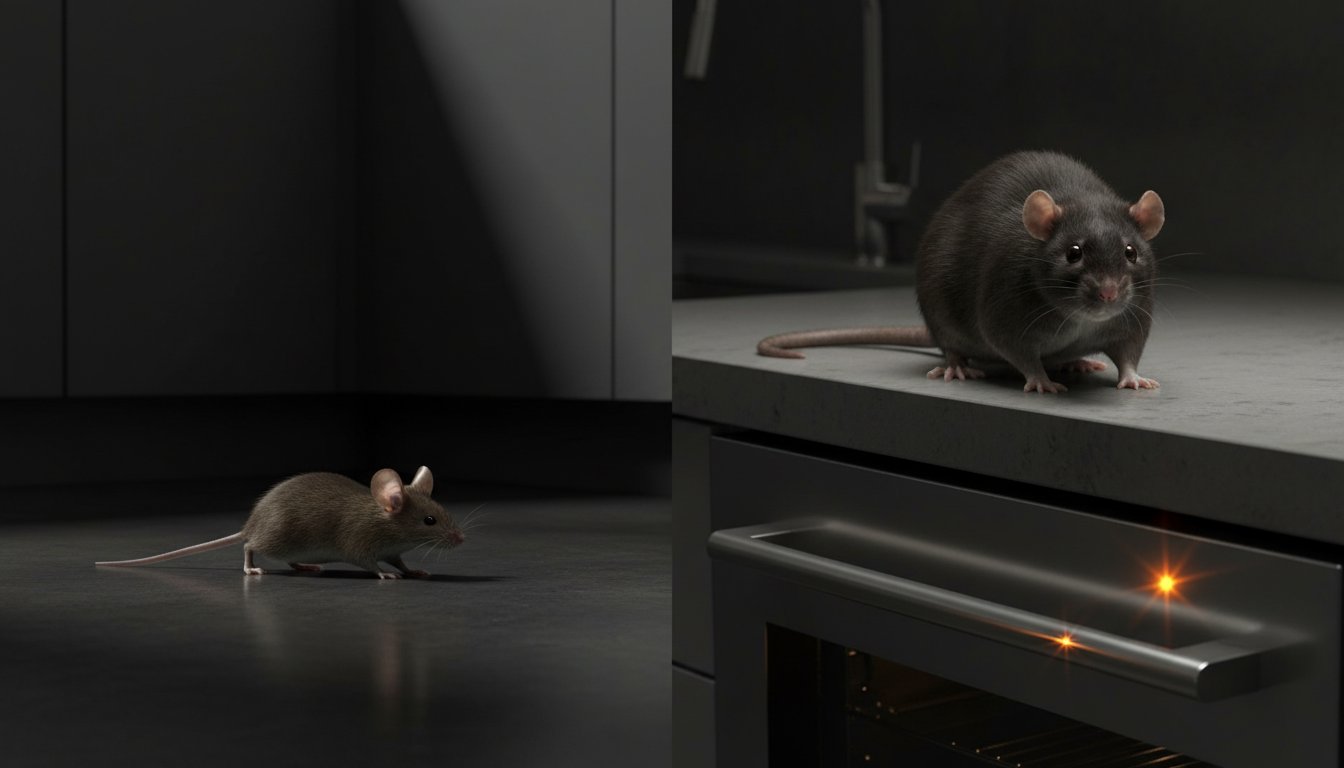
The "Rule of Proportions" is your best friend here. Don't just look at the total size of the animal. Look at the specific features. A baby rat will have oversized feet and a thick, scaly tail that looks like it belongs on a much larger animal. A mouse, even an old one, stays dainty. Its ears are huge compared to its head, and its tail is thin and slightly furry. Rats and mice both have four legs and fur, but that's where the similarities end for a professional. Identification is the first step I take when providing Structural Pest Control Services to ensure we use the right tools.
When I perform an inspection, I look for these markers to determine which strategy to use. Mice are curious and small, weighing barely an ounce. Rats are heavy hitters. A Norway rat can weigh over 10 times what a mouse weighs. They are cautious, strong, and capable of causing significant structural damage that a tiny mouse simply can't manage. You rarely have just one friendly visitor. If you see one, their family is already moving in. An adult mouse is about 3 to 4 inches long. A rat can easily double that length and add a massive amount of bulk.
Physical Markers of the Common House Mouse
The house mouse is built for speed and stealth. They have small, triangular heads and large, floppy ears that give them a nervous, alert look. Their tails are long and thin, usually covered in a very light layer of fine fur. You'll mostly see them in light brown or dusty gray shades with a lighter, cream colored belly. They are small enough to fit through a hole the size of a pencil, which makes them experts at finding ways into your pantry.
Physical Markers of Sacramento Rats (Roof vs. Norway)
Sacramento deals with two main rat types: the Roof rat and the Norway rat. Both have blunt snouts and small, hairless ears that look tiny compared to their skull size. Norway rats have thick, scaly tails that are shorter than their bodies, while Roof rats have tails longer than their bodies. These rodents are massive compared to mice. Because they are so much heavier and stronger, they require heavy duty professional equipment to manage effectively. If you've seen these signs, it's time to ask, "Got Pests?" and get a professional plan in place.
Behavioral Differences: Why Rats Are 'Smarter' Than Mice
I often tell my neighbors that catching a rodent is 10% equipment and 90% psychology. When you are looking at a mouse vs rat problem, you aren't just comparing body sizes. You are comparing two very different personalities. Mice are curious explorers that will investigate almost anything new in their environment. Rats, however, are cautious survivors. This behavioral gap is usually why a homeowner can catch five mice in a week but can't seem to touch the rat living in their attic.
The biggest hurdle in rat control is a trait called neophobia, which is a literal "fear of new things." If I place a new trap in a rat's path, that rat will likely avoid the area for days. They are suspicious of changes. They often wait for a "scout" or a lower ranking member of the colony to test the food first. Mice don't have this hangup. They see a new object and immediately want to know if it's edible. This makes mice much easier for a DIYer to handle, while rats often require the specialized Structural Pest Control Services I provide to get around their natural defenses.
Their diets and travel habits also differ wildly. Mice are picky eaters that prefer grains and seeds, usually nesting within 10 to 30 feet of their food source. Rats are opportunistic garbage disposals. They will eat anything from pet food to rotting fruit, and they are willing to travel 100 feet or more from their nest to find a meal. If you've seen signs of rat or mouse infestation like chewed wires or torn insulation, you are likely dealing with two very different mindsets.
The Mouse Mindset: Curiosity Kills
Mice are bold. Because they are curious, they are easily caught with new traps on the very first night. They live in tight social structures and can quickly colonize a pantry because they don't feel the need to scout for danger. If you have mice, you'll find them nesting in warm spots very close to where you store your snacks. They don't like to travel far, so their damage is usually localized but intense.
The Rat Strategy: Survival of the Cautious
A rat's strategy is built on caution. An alpha rat will let others take the risks, making it very difficult to bait a creature that fears change. They scout new objects and wait for a sense of safety before approaching. This is why I use customized "Got Pests?" strategies that account for this intelligence. If you're tired of being outsmarted by a rodent, I can help you with Structural Pest Control Services that target these specific survival behaviors.
Droppings, Damage, and Noises: Identifying the Evidence
Finding evidence of a rodent in your Sacramento home is never a good feeling. Whether it is a few dark specks on the kitchen counter or a strange thumping in the attic, you need to know exactly what you are up against. This is where the mouse vs rat identification process gets real. You don't want to guess regarding your family's hygiene and safety. I have spent years crawling through local crawlspaces and attics; I can tell you that the evidence left behind tells a very specific story.
The 'Poop' Test: A Definitive Guide
Look closely at the shape of any droppings you find. Mouse droppings are pointed and 3 to 8mm long, resembling black rice. You'll see 50 to 75 daily near food. Rat droppings are blunt, 12mm or longer, and look like olive pits. They leave about 40 daily, usually in clusters in the attic. Soft, dark droppings mean an active problem.
The location of these droppings is just as important as the size. Mice are "dribblers," meaning they leave a trail of waste wherever they wander, usually in your pantry or along the back of your silverware drawer. Rats are more organized. They tend to create "latrine" areas in hidden corners of a garage or attic. If you find a large pile of blunt droppings in the corner of your crawlspace, you are almost certainly dealing with a rat rather than a mouse.
Structural Damage and Nesting Signs
Mice shred paper and insulation for nests in closets or behind appliances. Rats chew through wood, plastic, and even lead pipes. Look for 'greasy' smudge marks along baseboards; these are sebum trails from their fur. You can read more about Managing Mice and Rats here. In Sacramento, rats often nest in attics or burrows under foundations.
Identifying the difference in sound is another way to settle the mouse vs rat debate in your head before you even see the animal. A mouse sounds like light scratching or fast scurrying. It is annoying but usually quiet. A rat, especially a large Norway rat, can sound like a heavy thumping or a dragging noise. If it sounds like a small dog is running across your ceiling, you're looking at a rat problem. I've heard these sounds in Auburn and Roseville homes for years, and they always point to a specific pest.
Got Pests? If you are seeing these signs, I am ready to help you clear them out with my professional Structural Pest Control Services. Don't let the damage to your wiring or insulation get worse before you take action.

The Sacramento Rodent Calendar: Local Risks and Timing
The Sacramento Valley has a rhythm that every local knows by heart. Our scorching summers and wet winters don't just change our weekend plans; they dictate exactly when rodents try to move into your home. While the mouse vs rat debate usually focuses on what they look like, in our area, it's also about when they show up. I've seen a clear pattern over the years. When the Central Valley heat hits those triple digits in July and August, rodents come looking for your air conditioning and dripping pipes. They need water and a break from the sun just as much as we do.
As we move into fall and winter, the pressure shifts. This is the peak invasion season for homeowners in Roseville and Auburn. When the first rains hit, the fields and creek beds become less hospitable. That is when your garage or crawlspace starts looking like a five star hotel. If you live near the agricultural edges of Lincoln or Rocklin, you face unique pressure. Harvesting crops in the nearby fields often flushes entire colonies of mice and rats toward the nearest residential structures. I've noticed that these homes often see a spike in activity right as the local harvest ends.
Roof Rats: Sacramento's High-Climbing Pest
Sacramento is famous for its tree canopy, but those beautiful old trees are essentially highways for Roof rats. These pests love our local fruit trees and thick ivy. They don't need a hole at ground level to get in. They use overhanging branches as a sky bridge to reach your roof. Once there, they squeeze through roof vents or gaps in your eaves. Because they prefer high places, you'll hear them thumping in the attic rather than the floorboards. Keeping your trees trimmed back at least 6 feet from your roofline is a simple way to cut off their access.
Norway Rats: The Foundation Dwellers
Norway rats are the heavyweights of the local rodent world. They are common in Sacramento's older sewer systems and damp crawl spaces. Unlike their roof climbing cousins, Norway rats are foundation dwellers. They undermine foundations with extensive burrowing. During flood years in the Valley, I see a massive increase in Norway rat sightings. As the water table rises, these rats are forced out of their burrows and sewer pipes, leading them straight into your home's lower levels.
Whether you're dealing with a high climbing Roof rat or a burrowing Norway rat, you need a plan that fits the season. If you've heard noises or seen damage, it's time to ask, "Got Pests?" and get a professional on-site. I provide hands-on Structural Pest Control Services that are designed specifically for Sacramento's unique rodent calendar. Don't wait for the winter rush to secure your home. I am ready to help you protect your property today.
Why I C Pests is Your Best Bet for Rodent Control
When you're staring at the damage in your attic or pantry, the mouse vs rat debate isn't just academic anymore. It's about taking your home back from intruders that don't belong there. I started I C Pests in 2018 because I saw how the big franchises treat customers like numbers on a spreadsheet. When you call me, you get me. I personally handle every inspection from the first walk through to the final seal up. I don't believe in one size fits all solutions. Instead, I use customized 'Got Pests?' strategies that account for the specific behaviors we've discussed, like rat neophobia and mouse curiosity.
I am also committed to keeping professional help affordable for my neighbors. If you have a quote from a larger company, let me see it. I will match or beat any competitor's price for local structural control. You get the expertise of a dedicated local pro without the corporate markup. My treatments are focused on being safe and effective. I prioritize methods that protect your family and pets while ensuring the rodents are gone for good. I've spent years learning the specific entry patterns of Sacramento rodents, and I take personal responsibility for every job I do.
The Problem with DIY Rodent Control
Many homeowners start with a trip to the hardware store for basic traps. These often fail against "educated" rat colonies. If a rat sees a friend get caught, they develop "trap shyness," which makes the survivors almost impossible to catch with standard DIY methods. This is why I don't just throw down traps and leave. I focus on exclusion first. By sealing every entry point with professional grade materials, we stop the cycle of infestation at the source. It's much more effective than just chasing the rodents that are already inside.
Get a Local Professional on Your Side
I have been serving Sacramento, Roseville, Auburn, and Lincoln since 2018. You won't have to deal with a corporate call center or a different technician every month. You have direct access to me, the owner, every step of the way. I know the local neighborhoods and the specific pressures our Valley climate puts on your home. If you're tired of hearing scratching in your walls and want a permanent solution, let me match your best quote and solve your rodent problem today! I provide the Structural Pest Control Services you need to keep your home secure and pest free.
Take Back Your Home From Rodent Intruders
Identifying a mouse vs rat problem is the first step toward a pest-free home. Remember that body proportions like ear size and tail thickness tell the real story. Don't let a young rat fool you into using a strategy designed for a mouse. Since rats are naturally cautious and mice are curious, your management plan has to match their specific psychology to be effective. With Sacramento's heat and seasonal rains driving these pests indoors, staying ahead of the rodent calendar is essential for protecting your property.
I have been a licensed technician since 2005 and take pride in being locally owned and operated right here in Sacramento. You don't have to settle for high corporate rates or faceless service. I offer a price-matching guarantee against major franchises to ensure you get the best value alongside my expert Structural Pest Control Services. Got Pests? Let me give you a better price and a better result; contact I C Pests today! I am ready to help you reclaim your space and give you the peace of mind you deserve.
Frequently Asked Questions
Can you have both mice and rats in the same house?
It's possible to have both, but they rarely share the same space. Rats are known to hunt and kill mice to eliminate competition for food. If you have both, they'll usually stick to different areas. You might find mice in the kitchen cabinets while rats take over the attic or crawlspace. I've seen this happen in larger Sacramento homes where there is enough room for both colonies to keep their distance.
Is a mouse or a rat more dangerous to my health?
Both rodents carry serious diseases like Hantavirus and Salmonella, but rats often pose a higher risk due to their size. They produce more waste and can be more aggressive if they feel cornered. Whether it is a mouse vs rat problem, the real danger is the contamination of your food and air. I take these health risks seriously and focus on thorough sanitation as part of my Structural Pest Control Services.
How do I know if I have a baby rat or an adult mouse?
Check the feet and the tail. A baby rat will have feet that look way too large for its body, almost like it hasn't grown into them yet. An adult mouse has small, dainty feet and a much thinner tail. Baby rats also have blunt snouts, while mice have more pointed, triangular faces. If you aren't sure, I can help you identify them during a personal inspection to ensure we use the right strategy.
Will cats or dogs keep mice and rats away?
Pets might catch a stray rodent now and then, but they won't stop an infestation. Most domestic pets aren't interested in the hard work of hunting a colony. In fact, I often find that pet food left out in Roseville garages is exactly what attracted the rodents in the first place. You shouldn't rely on your dog or cat to do the job of a professional exterminator.
What is the fastest way to get rid of a rat vs. a mouse?
The fastest way is a combination of professional trapping and total exclusion. Mice are easier to catch because they're curious, but rats require a more tactical approach to overcome their fear of new objects. I focus on sealing the entry points first so no new rodents can get in while I clear out the ones already inside. This "Got Pests?" approach is much faster than waiting for store bought traps to work.
Do rats come out during the day if there is an infestation?
Seeing a rat during the day is usually a sign of a large infestation. These animals are nocturnal, so they prefer to move under the cover of darkness. If you see them while the sun is up, it often means the nest is overcrowded or there is a major struggle for food. It's a clear signal that you need to take action immediately before the population grows even larger.
How much does a professional rodent exterminator cost in Sacramento?
Costs in the Sacramento area depend on the size of your home and how much repair work is needed to seal entry points. I don't believe in overcharging my neighbors for essential services. I invite you to get a quote from a larger franchise and then let me match or beat it. My goal is to provide a better result at a price that makes sense for your budget.
Can rats and mice climb walls to get into my attic?
Yes, both species are expert climbers. They can easily scale stucco, brick, and even some types of siding. They also use utility lines, downspouts, and overhanging tree branches as bridges to reach your roof. Once they find a gap in your eaves or a loose vent, they're inside. That is why I am so thorough about checking every inch of your roofline during my inspections.